Visualizzazione post con etichetta cervical cancer. Mostra tutti i post

sabato 30 luglio 2011

male circumcision to prevent HIV and HPV infections


Male circumcision, i.e.  the surgical removal of some or all of the foreskin (or prepuce) from the penis, has been associated with a lower risk for HIV infection in international observational studies and in three randomized controlled clinical trials. How can it be explained? Compared with the dry external skin surface, the inner mucosa of the foreskin is thinner than other penile skin, has a higher density of cells which are targets for HIV, and shows greater susceptibility to traumatic epithelial disruptions (tears) during intercourse, providing a portal of entry for pathogens, including HIV. In addition, the microenvironment in the preputial sac between the unretracted foreskin and the glans penis may be conducive to viral survival. Removal of prepuce from the penis causes a transformation of this mucosa which becomes thicker and less susceptible to trauma and infection.  It has been shown that  male circumcision could reduce male-to-female transmission of HIV, although probably to a lesser extent than female-to-male transmission. Although links between circumcision, culture, religion, and risk behavior may account for some of the differences in HIV infection prevalence, the countries in Africa and Asia with prevalence of male circumcision of less than 20% have HIV infection prevalences several times higher than those in countries in these regions where more than 80% of men are circumcised. Lack of male circumcision has also been associated with sexually transmitted genital ulcer disease and chlamydia, infant urinary tract infections, penile cancer, and cervical cancer in female partners of uncircumcised men. The latter two conditions are related to human papillomavirus (HPV) infection. Male circumcision may represent an effective additional procedure to primarily prevent cervical cancer in women living in African countries, the other being safe sex, vaccination of females and males against HPV.


Diversi studi scientifici hanno dimostrato che la circoncisione nel maschio, cioè la rimozione del prepuzio dal pene, si associa ad una diminuzione del rischio di infezione da HIV. Quale ne è il motivo? In effetti, la mucosa del pene che sta all’interno del prepuzio è più sottile della cute esterna del prepuzio stesso, contiene una quantità superiore di cellule che sono il bersaglio del virus HIV ed, essendo più delicata, risulta più suscettibile a microtraumi. Infine il microambiente del sacco prepuziale favorisce la concentrazione del virus. Se invece si rimuove la porzione retraibile di cute e mucosa che riveste il sacco prepuziale, la mucosa sottostante si trasforma diventando più spessa e più simile alla cute. Ciò riduce fortemente il rischio di contrarre l’infezione e di ritrasmetterla. A riprova di ciò è stato osservato che nei paesi in cui la circoncisione è praticata in meno del 20% della popolazione maschile, la prevalenza della malattia è di molto superiore a quella riscontrata nei paesi in cui la circoncisione è praticata in più dell’80% dei maschi. La mancanza di circoncisione favorisce inoltre l’incremento di altre malattie sessualmente trasmesse, come le ulcere genitali, le infezioni urinarie infantili, le infezioni da clamidia, il carcinoma del pene e il carcinoma della cervice uterina nelle partner degli uomini non circoncisi. Queste due forme di carcinoma sono dovute all’infezione da virus papilloma umano (HPV). La circoncisione maschile può rappresentare un ulteriore mezzo per favorire la prevenzione primaria del carcinoma della cervice uterina aggiungendosi alla modifica degli stili di vita e alla vaccinazione contro il virus sia delle femmine che dei maschi. 


martedì 1 marzo 2011

HPV vaccination and cervical cancer


Cervical cancer is the second most common cancer in women worldwide and it is linked to persistent infection by human papilloma virus (HPV). Vaccination against HPV represents an important tool to obtain a primary prevention of the tumor. There are many strains of the virus but only a small number of them causes cancer. An international team of researchers has recently identified eight strains of the HPV responsible for more than 90% of cervical cancer cases. The study, which was published in the prestigious medical journal The Lancet, examined 60 years of data from 10575 cases of invasive cervical cancer in 38 countries. HPV was found in about 85% of cancer samples.  More than 90% of these cases were caused by  HPV types 16, 18, 45, 33, 31, 51, 58 and 35, in descending order of frequency. Only 1% of cases worldwide were linked to the infection by HPV types 26, 30, 61, 67, 69, 82 and 91. The former group of eight strains will represent the target for the next generation of HPV vaccines. Currently two vaccines are available in the market, Cervarix and Gardasil, which cover the infection by HPV strains 16 and 18. Gardasil covers 11 additional non oncogenic HPV strains which are responsible for genital warts.  Prophilactic efficacy of the two HPV vaccines is almost 100% and they can prevent cancer cases directly linked to infection by HPV strains 16 and 18. Efficacy of the vaccination is obviously dependent upon the recipient not having been already infected with that type of HPV.  Cancer cases due to 16 and 18 HPV strains represent about 60%-70% of total cases. Future efforts will focus on the production of second generation vaccines covering in addition the other six HPV strains (45, 33, 31, 51, 58 and 35) in order to prevent more than 90% of cases.

giovedì 10 febbraio 2011

HIV, HPV and cervical cancer in developing countries


Both Cervical cancer and HIV infection are sexually transmitted diseases with no immediate visible symptoms. Cervical cancer originates from a sexually transmitted disease named Human Papilloma virus (HPV) which silently grows in the cervix and later develops to invasive cervical cancer. There is a growing evidence in the medical literature that a difference exists between HIV/AIDS positive and HIV negative women in the incidence and aggressiveness of cervical cancer, and this latter tumor is now regarded as an AIDS defining illness. This is particulary true in the low income developing world. Researchers suggest that as women are living longer due to access to specific anti-retroviral drugs, they are at an increased risk of contracting cervical cancer. While access to antiretroviral therapy is beginning to reduce AIDS mortality worldwide, gynaecologic oncologists warn that women being treated for AIDS could end up dying of cervical cancer unless they have access to appropriate screening and treatment. In fact, HIV positive women commonly show invasive cancer ten years earlier than women who are HIV negative. Moreover, the incidence of the precursor of cervical cancer, i.e. cervical intraepithelial neoplasia (CIN) is 4-5 times higher among HIV-infected than HIV-negative women and girls. In conclusion, there is a need for successful integration of cervical cancer  and HIV/AIDS service especially in low income developing countries. Great efforts should be made to introduce HPV vaccination in young girls and to implement effective secondary prevention and early diagnosis of cervical cancer in HIV positive women.


domenica 6 febbraio 2011

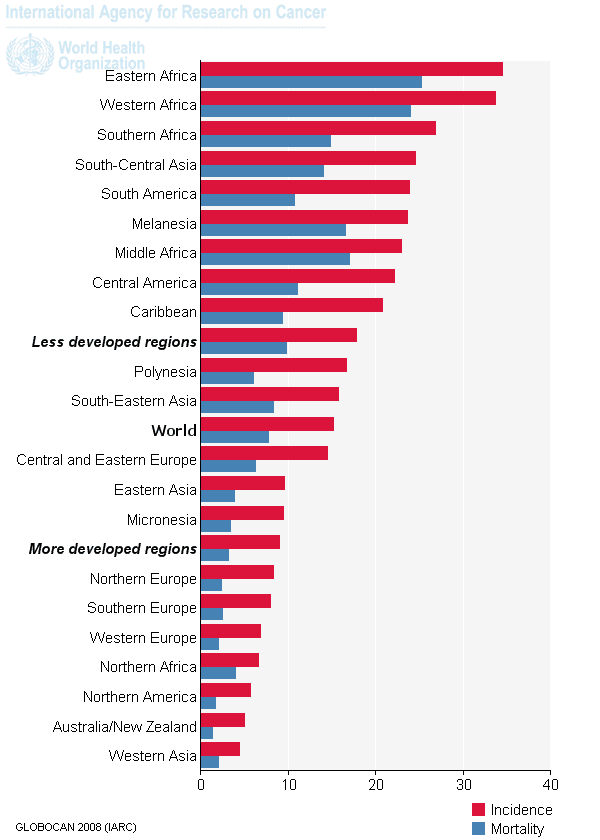
uterine cervical cancer incidence in 2008 worldwide


Estimated age-standardised rates (World) per 100,000


Here are some some updated data on the incidence of cervical cancer worldwide  according to the International agency for research on cancer (IARC). Cervical cancer is the third most common cancer in women, and the seventh overall, with an estimated 530 000 new cases in 2008. More than 85% of the global burden occurs in developing countries, where it accounts for 13% of all female cancers. High-risk regions are Eastern and Western Africa with age standardised incidence rate (ASR) greater then 30 per 100,000, Southern Africa (ASR 26.8 per 100,000), South-Central Asia (ASR 24.6 per 100,000), South America and Middle Africa (ASRs 23.9 and 23.0 per 100,000 respectively). Rates are lowest in Western Asia, Northern America and Australia/New Zealand (ASRs less than 6 per 100,00). Cervical cancer remains the most common cancer in women only in Eastern Africa, South-Central Asia and Melanesia. Overall, the mortality incidence ratio is 52%, and cervical cancer was responsible for 275 000 deaths in 2008, about 88% of which occurred in developing countries.

sabato 6 novembre 2010

Patterns of cancer in developed and developing countries


In other posts I have been talking about the differences in rankings between developed and developing (low- and middle-income) countries in both incidence and mortality for cancer. The patterns vary by geography and economic status, which correlate roughly with the causes of cancer in the "environment" in its broadest sense.
The majority of cancers in more developed countries are those associated with more affluent lyfestyles - cancers of the lung, colon and rectum, breast, and prostate. In contrast, cancers of the liver, stomach, esophagus, and cervix - all related directly or indirectly to infectious agents - are relatively more common in developing countries.  The mix of common cancer in females varies as seen in the following table (source: Cancer Control Opportunities in low- and middle-income countries; see website in the list). Click to enlarge:


In developed countries the incidence of tumors of the breast, colon, lung and corpus uteri is higher than in low- and middle-income countries with a ratio, respectively, of 1.23/1; 1.95/1; 1.02/1; and 2.19/1. The mortality of these malignancies, however, is lower than in developing countries: breast 29.8% vs. 42.8%; colon and rectum 49.3% vs. 60.0%; lung 82.5% vs. 86.5%; and corpus uteri 21.32% vs. 33.8%. The higher mortality of these tumors in the developing world is mainly due to a significant delay in the diagnosis of the disease, i.e. the tumor is disclosed in a more advanced stage of progression, when therapy is less effective or useless. Because of these factors, the number of people dying of breast cancer and lung cancer in developing countries is likely to be equal to or even higher than the number of subjects dying of these tumors in the developed world.
In developing countries the incidence of tumors of the cervix uteri, stomach, liver, and esophagus, is much higher than in developed countries with ratios, respectively, of 6.49/1; 1.86/1; 4.08/1, and 8.12/1. The higher incidence of these tumors is broadly explicable by differences in exposure to certain infectious agents (HPV, HBV, HIV, etc) or carcinogens, but it is also strongly related to the lack of primary prevention (vaccination against HPV and HBV), to an ineffective secondary prevention (i.e., screening of carcinoma of cervix uteri), and to the lack of health facilities for early diagnosis and treatment. In fact, it is very frustrating to realize that in developing countries a significant proportion of people dying for cancer were suffering from preventable and/or curable malignancies. It is for this reason that all efforts should be made by the global cancer community to take immediate steps to slow and ultimately reverse the phenomenon.

Ho avuto già occasione di parlare delle differenze in termini di incidenza e mortalità dei tumori nei paesi sviluppati in confronto con quelli in via di sviluppo. Tali differenze si articolano in base alla geografia e alle condizioni economiche e quindi, in generale, alle condizioni ambientali nel senso più largo del termine. In genere, nei paesi sviluppati l'incidenza più elevata di alcune forme tumorali  (carcinoma del polmone, colon e retto, mammella e prostata) è correlata agli stili di vita più seguiti. Nei paesi in via di sviluppo, invece, si osserva una maggiore incidenza dei tumori associati, direttamente o indirettamente, all'esposizione ad agenti infettivi (carcinoma del fegato, della cervice uterina, dello stomaco e dell'esofago). Tutte queste forme tumorali sono molto aggressive ad eccezione, almeno in parte, del carcinoma della cervice uterina. La variabilità di incidenza e mortalità nel sesso femminile sono ben illustrate nella tabella.
Nei paesi sviluppati l'incidenza del carcinoma della mammella, colon, polmone, corpo uterino, è più elevata che nei paesi in via di sviluppo in ragione, rispettivamente, di 1.23/1; 1.95/1; 1.02/1; e 2.19/1.  La mortalità di questi tumori, però, è meno elevata che nei paesi in via di sviluppo: mammella 29.8% vs. 42.8%; colon e retto 49.3% vs. 60.0%; polmone 82.5% vs. 86.5%; corpo uterino 21.32% vs. 33.8%. Tutto ciò è dovuto al ritardo con il quale viene identificata la malattia che preclude l'efficacia delle terapie perchè il tumore si trova in una fase più avanzata. Come diretta conseguenza, la mortalità almeno per cancro della mammella e del polmone è più elevata nei paesi in via di sviluppo anche se l'incidenza è inferiore rispetto ai paesi sviluppati.
Nei paesi in via di sviluppo l'incidenza del carcinoma della cervice uterina, dello stomaco, del fegato, e dell'esofago è molto superiore a quella che si riscontra nei paesi sviluppati, in ragione, rispettivamente, di 6.49/1; 1.86/1; 4.08/1, e 8.12/1. L'incidenza più elevata è riconducibile alla diversa esposizione ad agenti infettivi (HPV, HBV, HIV, ecc) o carcinogeni, ma anche alla totale mancanza di misure di prevenzione primaria (vaccinazioni anti HBV o HPV), o all'insufficienza di misure di prevenzione secondaria (p.es. lo screening per il carcinoma della cervice uterina) e, infine, alla mancanza di strutture sanitarie che consentano una diagnosi precoce con relativo trattamento. E' sconfortante pensare che nei paesi in via di sviluppo la maggioranza dei decessi per cancro sia correlata a tumori prevenibili o curabili se diagnosticati in tempo. Tutto ciò deve rappresentare per la comunità globale che si occupa di cancro un motivo per attivarsi in modo fattivo affinchè tale tendenza venga ridotta o addirittura invertita.