Visualizzazione post con etichetta cancer incidence. Mostra tutti i post

domenica 6 febbraio 2011

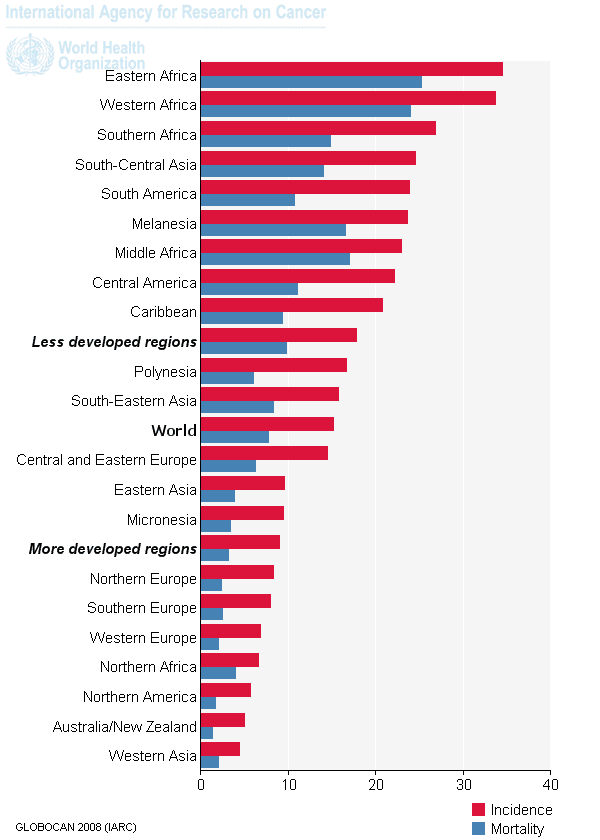
uterine cervical cancer incidence in 2008 worldwide


Estimated age-standardised rates (World) per 100,000


Here are some some updated data on the incidence of cervical cancer worldwide  according to the International agency for research on cancer (IARC). Cervical cancer is the third most common cancer in women, and the seventh overall, with an estimated 530 000 new cases in 2008. More than 85% of the global burden occurs in developing countries, where it accounts for 13% of all female cancers. High-risk regions are Eastern and Western Africa with age standardised incidence rate (ASR) greater then 30 per 100,000, Southern Africa (ASR 26.8 per 100,000), South-Central Asia (ASR 24.6 per 100,000), South America and Middle Africa (ASRs 23.9 and 23.0 per 100,000 respectively). Rates are lowest in Western Asia, Northern America and Australia/New Zealand (ASRs less than 6 per 100,00). Cervical cancer remains the most common cancer in women only in Eastern Africa, South-Central Asia and Melanesia. Overall, the mortality incidence ratio is 52%, and cervical cancer was responsible for 275 000 deaths in 2008, about 88% of which occurred in developing countries.

giovedì 6 gennaio 2011

women's poverty, HIV infection, and cancer


Women bear a disproportionate burden of the world’s poverty. Statistics indicate that they are more likely than men to be poor and at risk of hunger. This is certainly due to  the systematic discrimination they face in education, health care, employment and control of assets.  According to some estimates, women represent 70 percent of the world’s poor.  
More than 30 million people are today living with HIV and, globally, women now account for half of all infections. Yet women increasingly make up the majority in sub-Saharan Africa where young women ages 15–24 are up to six times more likely to be HIV-positive than young men of the same age.
Why does it happen? According to the UN women website,  “gender inequality and violations of women’s rights make women and girls particularly susceptible, leaving them with less control than men over their bodies and their lives. Women and girls often have less information about HIV and fewer resources to take preventive measures. They face barriers to the negotiation of safer sex, including economic dependency and unequal power relations”.
What about women’s poverty and cancer incidence and mortality? I have already reported the higher incidence and the higher mortality of carcinoma of the cervix uteri in the developing world as compared to the high-income western world which is mainly due to the lack of primary or secondary prevention. Every day in Africa many women die of this totally preventable cancer which is related to human papilloma virus (HPV) infection.  Most of them even ignored the disease they were suffering from. Other than the lack of medical care and health facilities in the countries they live in, gender inequality and violations of women’s rights do play a major role in this tragedy too.


sabato 6 novembre 2010

Patterns of cancer in developed and developing countries


In other posts I have been talking about the differences in rankings between developed and developing (low- and middle-income) countries in both incidence and mortality for cancer. The patterns vary by geography and economic status, which correlate roughly with the causes of cancer in the "environment" in its broadest sense.
The majority of cancers in more developed countries are those associated with more affluent lyfestyles - cancers of the lung, colon and rectum, breast, and prostate. In contrast, cancers of the liver, stomach, esophagus, and cervix - all related directly or indirectly to infectious agents - are relatively more common in developing countries.  The mix of common cancer in females varies as seen in the following table (source: Cancer Control Opportunities in low- and middle-income countries; see website in the list). Click to enlarge:


In developed countries the incidence of tumors of the breast, colon, lung and corpus uteri is higher than in low- and middle-income countries with a ratio, respectively, of 1.23/1; 1.95/1; 1.02/1; and 2.19/1. The mortality of these malignancies, however, is lower than in developing countries: breast 29.8% vs. 42.8%; colon and rectum 49.3% vs. 60.0%; lung 82.5% vs. 86.5%; and corpus uteri 21.32% vs. 33.8%. The higher mortality of these tumors in the developing world is mainly due to a significant delay in the diagnosis of the disease, i.e. the tumor is disclosed in a more advanced stage of progression, when therapy is less effective or useless. Because of these factors, the number of people dying of breast cancer and lung cancer in developing countries is likely to be equal to or even higher than the number of subjects dying of these tumors in the developed world.
In developing countries the incidence of tumors of the cervix uteri, stomach, liver, and esophagus, is much higher than in developed countries with ratios, respectively, of 6.49/1; 1.86/1; 4.08/1, and 8.12/1. The higher incidence of these tumors is broadly explicable by differences in exposure to certain infectious agents (HPV, HBV, HIV, etc) or carcinogens, but it is also strongly related to the lack of primary prevention (vaccination against HPV and HBV), to an ineffective secondary prevention (i.e., screening of carcinoma of cervix uteri), and to the lack of health facilities for early diagnosis and treatment. In fact, it is very frustrating to realize that in developing countries a significant proportion of people dying for cancer were suffering from preventable and/or curable malignancies. It is for this reason that all efforts should be made by the global cancer community to take immediate steps to slow and ultimately reverse the phenomenon.

Ho avuto già occasione di parlare delle differenze in termini di incidenza e mortalità dei tumori nei paesi sviluppati in confronto con quelli in via di sviluppo. Tali differenze si articolano in base alla geografia e alle condizioni economiche e quindi, in generale, alle condizioni ambientali nel senso più largo del termine. In genere, nei paesi sviluppati l'incidenza più elevata di alcune forme tumorali  (carcinoma del polmone, colon e retto, mammella e prostata) è correlata agli stili di vita più seguiti. Nei paesi in via di sviluppo, invece, si osserva una maggiore incidenza dei tumori associati, direttamente o indirettamente, all'esposizione ad agenti infettivi (carcinoma del fegato, della cervice uterina, dello stomaco e dell'esofago). Tutte queste forme tumorali sono molto aggressive ad eccezione, almeno in parte, del carcinoma della cervice uterina. La variabilità di incidenza e mortalità nel sesso femminile sono ben illustrate nella tabella.
Nei paesi sviluppati l'incidenza del carcinoma della mammella, colon, polmone, corpo uterino, è più elevata che nei paesi in via di sviluppo in ragione, rispettivamente, di 1.23/1; 1.95/1; 1.02/1; e 2.19/1.  La mortalità di questi tumori, però, è meno elevata che nei paesi in via di sviluppo: mammella 29.8% vs. 42.8%; colon e retto 49.3% vs. 60.0%; polmone 82.5% vs. 86.5%; corpo uterino 21.32% vs. 33.8%. Tutto ciò è dovuto al ritardo con il quale viene identificata la malattia che preclude l'efficacia delle terapie perchè il tumore si trova in una fase più avanzata. Come diretta conseguenza, la mortalità almeno per cancro della mammella e del polmone è più elevata nei paesi in via di sviluppo anche se l'incidenza è inferiore rispetto ai paesi sviluppati.
Nei paesi in via di sviluppo l'incidenza del carcinoma della cervice uterina, dello stomaco, del fegato, e dell'esofago è molto superiore a quella che si riscontra nei paesi sviluppati, in ragione, rispettivamente, di 6.49/1; 1.86/1; 4.08/1, e 8.12/1. L'incidenza più elevata è riconducibile alla diversa esposizione ad agenti infettivi (HPV, HBV, HIV, ecc) o carcinogeni, ma anche alla totale mancanza di misure di prevenzione primaria (vaccinazioni anti HBV o HPV), o all'insufficienza di misure di prevenzione secondaria (p.es. lo screening per il carcinoma della cervice uterina) e, infine, alla mancanza di strutture sanitarie che consentano una diagnosi precoce con relativo trattamento. E' sconfortante pensare che nei paesi in via di sviluppo la maggioranza dei decessi per cancro sia correlata a tumori prevenibili o curabili se diagnosticati in tempo. Tutto ciò deve rappresentare per la comunità globale che si occupa di cancro un motivo per attivarsi in modo fattivo affinchè tale tendenza venga ridotta o addirittura invertita.