Visualizzazione post con etichetta carcinoma of the cervix uteri. Mostra tutti i post

sabato 30 luglio 2011

male circumcision to prevent HIV and HPV infections


Male circumcision, i.e.  the surgical removal of some or all of the foreskin (or prepuce) from the penis, has been associated with a lower risk for HIV infection in international observational studies and in three randomized controlled clinical trials. How can it be explained? Compared with the dry external skin surface, the inner mucosa of the foreskin is thinner than other penile skin, has a higher density of cells which are targets for HIV, and shows greater susceptibility to traumatic epithelial disruptions (tears) during intercourse, providing a portal of entry for pathogens, including HIV. In addition, the microenvironment in the preputial sac between the unretracted foreskin and the glans penis may be conducive to viral survival. Removal of prepuce from the penis causes a transformation of this mucosa which becomes thicker and less susceptible to trauma and infection.  It has been shown that  male circumcision could reduce male-to-female transmission of HIV, although probably to a lesser extent than female-to-male transmission. Although links between circumcision, culture, religion, and risk behavior may account for some of the differences in HIV infection prevalence, the countries in Africa and Asia with prevalence of male circumcision of less than 20% have HIV infection prevalences several times higher than those in countries in these regions where more than 80% of men are circumcised. Lack of male circumcision has also been associated with sexually transmitted genital ulcer disease and chlamydia, infant urinary tract infections, penile cancer, and cervical cancer in female partners of uncircumcised men. The latter two conditions are related to human papillomavirus (HPV) infection. Male circumcision may represent an effective additional procedure to primarily prevent cervical cancer in women living in African countries, the other being safe sex, vaccination of females and males against HPV.


Diversi studi scientifici hanno dimostrato che la circoncisione nel maschio, cioè la rimozione del prepuzio dal pene, si associa ad una diminuzione del rischio di infezione da HIV. Quale ne è il motivo? In effetti, la mucosa del pene che sta all’interno del prepuzio è più sottile della cute esterna del prepuzio stesso, contiene una quantità superiore di cellule che sono il bersaglio del virus HIV ed, essendo più delicata, risulta più suscettibile a microtraumi. Infine il microambiente del sacco prepuziale favorisce la concentrazione del virus. Se invece si rimuove la porzione retraibile di cute e mucosa che riveste il sacco prepuziale, la mucosa sottostante si trasforma diventando più spessa e più simile alla cute. Ciò riduce fortemente il rischio di contrarre l’infezione e di ritrasmetterla. A riprova di ciò è stato osservato che nei paesi in cui la circoncisione è praticata in meno del 20% della popolazione maschile, la prevalenza della malattia è di molto superiore a quella riscontrata nei paesi in cui la circoncisione è praticata in più dell’80% dei maschi. La mancanza di circoncisione favorisce inoltre l’incremento di altre malattie sessualmente trasmesse, come le ulcere genitali, le infezioni urinarie infantili, le infezioni da clamidia, il carcinoma del pene e il carcinoma della cervice uterina nelle partner degli uomini non circoncisi. Queste due forme di carcinoma sono dovute all’infezione da virus papilloma umano (HPV). La circoncisione maschile può rappresentare un ulteriore mezzo per favorire la prevenzione primaria del carcinoma della cervice uterina aggiungendosi alla modifica degli stili di vita e alla vaccinazione contro il virus sia delle femmine che dei maschi. 


giovedì 5 maggio 2011

HPV vaccination in male to prevent uterine cervical cancer


The origin of cancer of the cervix uteri is directly linked to a chronic infection of selected (so called “high risk”) types of human papilloma virus (HPV).  The virus is readily transmitted from men to women by the sexual intercourse and greatly affects the risk of disease in women. It is for this reason that understanding the nature of HPV in men is of crucial public health importance and can be used in modeling to establish whether vaccinating men against HPV would be cost effective. An Article published by Professor Anna R Giuliano and colleagues, of the H Lee Moffitt Cancer Center and Research Institute, Tampa, FL, USA, in the prestigous medical journal the Lancet  shows that approximately 50% of men from a sample of the general population are infected with the virus. The study analysed 1159 men aged 18 to 70 years (mean 32 years) from the USA, Brazil, and Mexico, all of whom were HIV negative and had no history of cancer. They were assessed every six months for an average of more than two years. The incidence of a new genital HPV infection with any HPV type was 38.4 per 1000 person months. The chances of cancer-causing (oncogenic) HPV infection was 2.4 times higher from men who had had many female partners compared with no partners or just one partner. The authors say: 'We noted no association with age and incidence of any, oncogenic, or non-oncogenic HPV types, although the probability of clearing these infections increased with age." They conclude: "The incidence of genital HPV infection in men was high and relatively constant across age groups in Brazil, Mexico, and the USA. The results from this study provide much needed data about the incidence and clearance of HPV infection in men; these data are essential for the development of realistic cost-effectiveness models for male HPV vaccination internationally". HPV vaccination of men will protect not only them but will also have great implications for their sexual partner. Vaccination of both females and males could represent the best way to fight uterine cervical cancer.

domenica 6 febbraio 2011

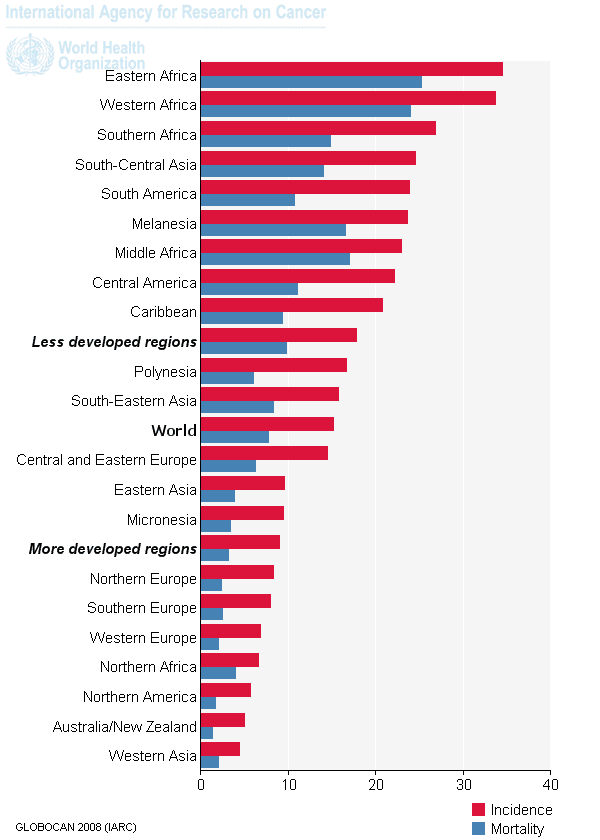
uterine cervical cancer incidence in 2008 worldwide


Estimated age-standardised rates (World) per 100,000


Here are some some updated data on the incidence of cervical cancer worldwide  according to the International agency for research on cancer (IARC). Cervical cancer is the third most common cancer in women, and the seventh overall, with an estimated 530 000 new cases in 2008. More than 85% of the global burden occurs in developing countries, where it accounts for 13% of all female cancers. High-risk regions are Eastern and Western Africa with age standardised incidence rate (ASR) greater then 30 per 100,000, Southern Africa (ASR 26.8 per 100,000), South-Central Asia (ASR 24.6 per 100,000), South America and Middle Africa (ASRs 23.9 and 23.0 per 100,000 respectively). Rates are lowest in Western Asia, Northern America and Australia/New Zealand (ASRs less than 6 per 100,00). Cervical cancer remains the most common cancer in women only in Eastern Africa, South-Central Asia and Melanesia. Overall, the mortality incidence ratio is 52%, and cervical cancer was responsible for 275 000 deaths in 2008, about 88% of which occurred in developing countries.

martedì 25 gennaio 2011

too early and too late cancer detection


In clinical practice, the suspicion of cancer leads to biopsy and biopsy generally requires surgical excision or removal of the lesion. As a matter of fact, sometimes the lesion turns to be benign (a cancer mimic) or premalignant (i.e. lacking the full features of malignancy) or, if malignant, to represent a very early step of the disease (and one cannot be sure that the tumor would have behaved as an aggressive disease if left untreated).  These possible events lead to overdiagnosis of cancer which is responsible for unjustified mutilation, anxiety of the patient, and cost escalation. A paper published in the  Journal of the National Cancer Institute in 2010 has stirred up another round of debate about this topic. To mitigate the ongoing problem of cancer overdiagnosis, the authors of the above paper suggest three possibilities: raising the threshold of labeling a test abnormal, waiting for the growth of a lesion over time before biopsying, and ignoring smaller abnormalities. In summary, we are realizing that it is better not to continue on the path where we are compelled to investigate and treat anything that resembles cancer. 
This is what is happening in the high-income developed countries of the world where screening procedures are highly effective in the detection of early cancer and its mimics. The best examples are cancer of the uterine cervix, the breast, the lung, etc. The opposite is true, instead, in the low-income developing countries where the above malignancies are detected too late due to the lack of resources in screening and secondary prevention, and the chance of successful treatment are low or null.  For example, it is estimated that over 1 million women worldwide currently have cervical cancer, most of whom (living in developing countries) have not been diagnosed, or have no access to treatment that could cure them or prolong their life. According to the World Health Organization, in 2005, almost 260 000 women died of the disease, nearly 95% of them in developing countries, making cervical cancer one of the gravest threats to women’s lives. In these areas, cervical cancer is the most common cancer in women and the leading cause of cancer death among women.

giovedì 6 gennaio 2011

women's poverty, HIV infection, and cancer


Women bear a disproportionate burden of the world’s poverty. Statistics indicate that they are more likely than men to be poor and at risk of hunger. This is certainly due to  the systematic discrimination they face in education, health care, employment and control of assets.  According to some estimates, women represent 70 percent of the world’s poor.  
More than 30 million people are today living with HIV and, globally, women now account for half of all infections. Yet women increasingly make up the majority in sub-Saharan Africa where young women ages 15–24 are up to six times more likely to be HIV-positive than young men of the same age.
Why does it happen? According to the UN women website,  “gender inequality and violations of women’s rights make women and girls particularly susceptible, leaving them with less control than men over their bodies and their lives. Women and girls often have less information about HIV and fewer resources to take preventive measures. They face barriers to the negotiation of safer sex, including economic dependency and unequal power relations”.
What about women’s poverty and cancer incidence and mortality? I have already reported the higher incidence and the higher mortality of carcinoma of the cervix uteri in the developing world as compared to the high-income western world which is mainly due to the lack of primary or secondary prevention. Every day in Africa many women die of this totally preventable cancer which is related to human papilloma virus (HPV) infection.  Most of them even ignored the disease they were suffering from. Other than the lack of medical care and health facilities in the countries they live in, gender inequality and violations of women’s rights do play a major role in this tragedy too.