domenica 6 febbraio 2011

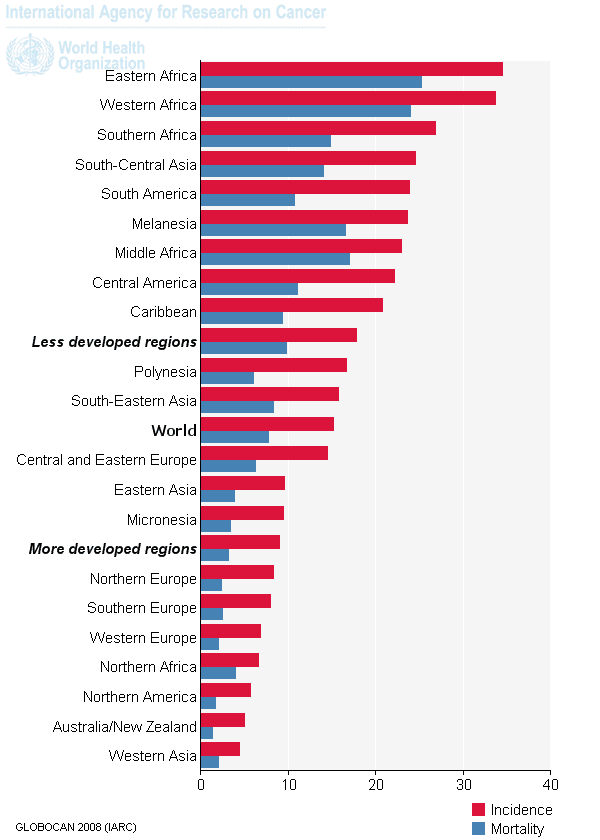
uterine cervical cancer incidence in 2008 worldwide


Estimated age-standardised rates (World) per 100,000


Here are some some updated data on the incidence of cervical cancer worldwide  according to the International agency for research on cancer (IARC). Cervical cancer is the third most common cancer in women, and the seventh overall, with an estimated 530 000 new cases in 2008. More than 85% of the global burden occurs in developing countries, where it accounts for 13% of all female cancers. High-risk regions are Eastern and Western Africa with age standardised incidence rate (ASR) greater then 30 per 100,000, Southern Africa (ASR 26.8 per 100,000), South-Central Asia (ASR 24.6 per 100,000), South America and Middle Africa (ASRs 23.9 and 23.0 per 100,000 respectively). Rates are lowest in Western Asia, Northern America and Australia/New Zealand (ASRs less than 6 per 100,00). Cervical cancer remains the most common cancer in women only in Eastern Africa, South-Central Asia and Melanesia. Overall, the mortality incidence ratio is 52%, and cervical cancer was responsible for 275 000 deaths in 2008, about 88% of which occurred in developing countries.

giovedì 3 febbraio 2011

africa needs a green revolution


Africa’s peasants are migrating to the cities in huge numbers because it is becoming increasingly difficult to survive on their farms. Meanwhile, very few are finding productive jobs in the cities and most are getting poorer. Africa’s dependance on concessionary food import is growing and these trends can have catastrophic consequences for the continent’s poor people. Current situation in Africa bears some striking similarities in Asia in the early 1960s. Faced with worsening food shortages and slow agricultural growth, Asian governments started spending 10-15% of their total budget on agriculture each year because they realised that rapid agricultural growth was a key step along the path to industrialisation. They invested on agricultural research, irrigation, rural roads and power.  Many of these interventions were targeted to small farms, who enthusiastically adopted the new technologies and typically outperformed larger farms. These policies inspired a green revolution that helped transform Asia. Africa, in contrast, has failed to do the same. For over 40 years African governments have spent less than half the share spent in Asia, and little has been done  for agricultural development. Africa has only exploited a fraction of its irrigation potential and the density of rural roads is very low. Farmers rely almost exclusively on rain-fed farming and face exceptionally high transport and marketing costs. Instead, yields could dramatically increase if farmers had access to improved technologies and markets and if goverments provided more supportive policies for agriculture. An African green revolution would generate many productive jobs in agriculture and provide a leg up out of poverty for many. This would help creating allied industries and lowering food prices, and, finally, would prevent migration of millions of peasants off the land. Two risks, however, should be taken into account: a) the spread of green revolution agriculture may affect both agricultural biodiversity and wild biodiversity; b) the consumption of the chemicals and pesticides used to kill pests by humans in some cases may be increasing the likelihood of cancer.
Click here to read more on the topic.

martedì 25 gennaio 2011

too early and too late cancer detection


In clinical practice, the suspicion of cancer leads to biopsy and biopsy generally requires surgical excision or removal of the lesion. As a matter of fact, sometimes the lesion turns to be benign (a cancer mimic) or premalignant (i.e. lacking the full features of malignancy) or, if malignant, to represent a very early step of the disease (and one cannot be sure that the tumor would have behaved as an aggressive disease if left untreated).  These possible events lead to overdiagnosis of cancer which is responsible for unjustified mutilation, anxiety of the patient, and cost escalation. A paper published in the  Journal of the National Cancer Institute in 2010 has stirred up another round of debate about this topic. To mitigate the ongoing problem of cancer overdiagnosis, the authors of the above paper suggest three possibilities: raising the threshold of labeling a test abnormal, waiting for the growth of a lesion over time before biopsying, and ignoring smaller abnormalities. In summary, we are realizing that it is better not to continue on the path where we are compelled to investigate and treat anything that resembles cancer. 
This is what is happening in the high-income developed countries of the world where screening procedures are highly effective in the detection of early cancer and its mimics. The best examples are cancer of the uterine cervix, the breast, the lung, etc. The opposite is true, instead, in the low-income developing countries where the above malignancies are detected too late due to the lack of resources in screening and secondary prevention, and the chance of successful treatment are low or null.  For example, it is estimated that over 1 million women worldwide currently have cervical cancer, most of whom (living in developing countries) have not been diagnosed, or have no access to treatment that could cure them or prolong their life. According to the World Health Organization, in 2005, almost 260 000 women died of the disease, nearly 95% of them in developing countries, making cervical cancer one of the gravest threats to women’s lives. In these areas, cervical cancer is the most common cancer in women and the leading cause of cancer death among women.

domenica 23 gennaio 2011

urbanisation and cancer in africa


Both in developed and low-income developing countries of the world more than half of humanity resides now in cities, and city dwellers make up more of the world population each year. Humanity is abandoning the countryside and soon more than 25 cities will have populations of 10 million or more. Rural areas depopulate because modern farming techniques require less labor and more technology. In developing countries more and more migrants each year are leaving marginal lands because little rain and poor soils keep agricultural productivity low. In fact, farming income cannot compete with economic opportunities in cities. A growing, affluent urban class thus drives demand in energy and consumer goods and is straining city infrastructure. 
Since 1955 Africa has witnessed the most rapid urbanisation of all the continents, giving rise to cities that rival some of the greatest in the world in terms of size and population although sadly not infrastructure. By the year 2025, 54.0 percent of the African population will reside in urban areas. Some of these cities are Kano, Cape Town, Johannesburg, Abidjan (all with a population of more than 3 million), Khartoum (Pop 4.5 million), Kinshasa (Pop 6.0 million), and Lagos (Pop 10.9 million). The growth of Africa’s population is high while the rates of economic growth are low. As a consequence the growth of available health facilities in these huge metropolitan areas cannot parallel the rate of people urbanisation. In these huge cities “new” diseases such as cancer will reach unexpected rates in the near future due to population growth and ageing, combined with reduced mortality from infectious disease, and lack of primary and secondary preventive actions. Urbanisation in Africa is thus likely to play a major role in favoring the cancer epidemic the continent will be faced to in few years.


giovedì 20 gennaio 2011

the 5/80 cancer disequilibrium


In october 2010 an important article appeared in the prestigious British medical journal “The Lancet” on the topic of cancer in the developing countries. I am reporting some statements: “Once thought to be a problem almost exclusive to the developed world, cancer is now a leading cause of death and disability, and thus a health priority, in poor countries”… “Low-income and middle-income countries now bear a majority share of the burden of cancer, but their health systems are particularly ill prepared to meet this challenge. The rising proportion of cases in these countries is caused by population growth and ageing, combined with reduced mortality from infectious disease. In 1970, 15% of newly reported cancers were in developing countries, compared with 56% in 2008. By 2030, the proportion is expected to be 70%”... “Overall, case fatality from cancer (calculated as an approximation from the ratio of incidence to mortality in a specific year) is estimated to be 75% in countries of low income, 72% in countries of low-middle income, 64% in countries of high-middle income, and 46% in countries of high income”… “Without prevention, antitobacco campaigns, vaccination against human papillomavirus (HPV) and hepatitis B virus, and focus on early detection of some tumors, growth of the cancer burden in these countries could make treatment virtually unaffordable in the long term”... “Only a small proportion of global resources for cancer are spent in countries of low and middle income: several studies have reported an estimate of 5%. By contrast, these countries together account for almost 80% of the disability-adjusted life-years lost worldwide to cancer. Cancer is an underfunded health problem and an important cause of premature death in resource- poor settings, resulting in this staggering “5/80 cancer disequilibrium”.

giovedì 6 gennaio 2011

women's poverty, HIV infection, and cancer


Women bear a disproportionate burden of the world’s poverty. Statistics indicate that they are more likely than men to be poor and at risk of hunger. This is certainly due to  the systematic discrimination they face in education, health care, employment and control of assets.  According to some estimates, women represent 70 percent of the world’s poor.  
More than 30 million people are today living with HIV and, globally, women now account for half of all infections. Yet women increasingly make up the majority in sub-Saharan Africa where young women ages 15–24 are up to six times more likely to be HIV-positive than young men of the same age.
Why does it happen? According to the UN women website,  “gender inequality and violations of women’s rights make women and girls particularly susceptible, leaving them with less control than men over their bodies and their lives. Women and girls often have less information about HIV and fewer resources to take preventive measures. They face barriers to the negotiation of safer sex, including economic dependency and unequal power relations”.
What about women’s poverty and cancer incidence and mortality? I have already reported the higher incidence and the higher mortality of carcinoma of the cervix uteri in the developing world as compared to the high-income western world which is mainly due to the lack of primary or secondary prevention. Every day in Africa many women die of this totally preventable cancer which is related to human papilloma virus (HPV) infection.  Most of them even ignored the disease they were suffering from. Other than the lack of medical care and health facilities in the countries they live in, gender inequality and violations of women’s rights do play a major role in this tragedy too.


domenica 2 gennaio 2011

malaria prevention is giving results


This is a new nice story about prevention.  The U.N. health agency says the billions of dollars poured into the program have helped buy anti-malaria nets for almost 600 million people in sub-Saharan Africa, and this has contributed to a drop of over 50 percent in malaria cases in 11 African countries. There are 106 countries in the world where malaria remains endemic. Forty-three of these countries are in sub-Saharan Africa, which is the heartland of malaria in terms of the number of cases and deaths and the severity of illness. Investment in malaria control brings results. After so many years of deterioration and stagnation in the malaria situation, countries and their development partners are now on the offensive.  In Africa, the distribution of insecticide-treated mosquito nets has increased dramatically.
In less than three years, the number of nets distributed has come close to the target of 350 million set in 2008. Also in Africa, the number of people protected by indoor residual spraying of insecticides rose 6-fold, from less than 13 million in 2005 to 75 million in 2009. In addition, worldwide, the number of ACT  treatment courses procured (Artemisinin-based combination therapies, i.e. the most effective antimalarial drugs) increased from just over 11 million in 2005 to 158 million in 2009. Such massive increases in the delivery of interventions produced in eleven of Africa’s 43 endemic countries reductions of greater than 50% in either confirmed malaria cases or deaths over the past decade.
Malaria is an extremely complex disease that has been causing deaths and social disruption since the beginning of recorded human history. This is the first time in the history of these countries that reported new cases or deaths are decreasing.