Visualizzazione post con etichetta pap smear. Mostra tutti i post

mercoledì 18 maggio 2011

uterine cervical cancer in the population of Nosy Be, Madagascar

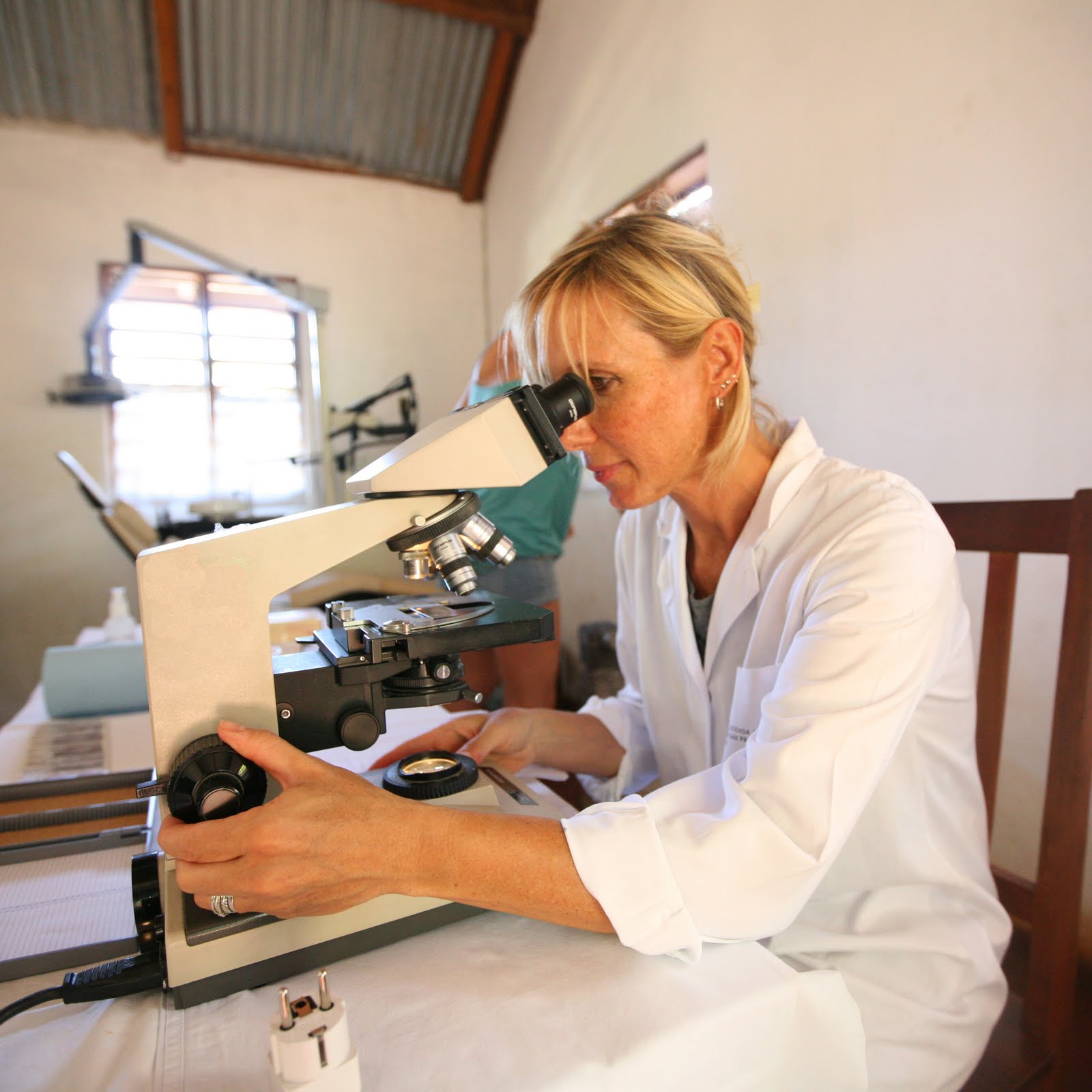
Pathologist at the microscope and local staff reviewing the cytological reports
In a previous post I described the results of a medical mission we made in september 2010 to promote secondary prevention of uterine cervical cancer by pap smear cytological screening in women living in Nosy Be Island, Madagascar. The mission was repeated in April 2011 and took place at the Dispensaire of the Organisation Medicale Interenterpresises of Nosy Be (OMINO) in Hellville. The data we collected confirm our previous results that in the population of Nosy Be the incidence of uterine cervical carcinoma and its precursor lesions is significantly high. 
So far, we have examined cumulatively 278 women aged 16 to 57. In both missions we managed to perform pap smear evaluation with immediate reporting and immediate colposcopy and biopsy on a same-day basis. To summarize, pap smear sampling started early in the morning and was performed by two physicians, then slides were immediately stained and interpreted by a Pathologist who was able to release a cytopathological report at the end of the morning. Then, women bearing abnormalities in their pap smear were invited to undergo immediate colposcopy which was performed in the  early afternoon. Biopsy samples were then collected and processed for histological evaluation. Histological processing was completed in Italy at the department of Pathology, Fatebenefratelli Hospital, in Milano, Italy. 

women waiting for their turn for pap smear sampling
Immediate cytological reporting allowed for women with pap smear abnormalities to undergo immediate colposcopy thus preventing the risk of patients’ drop out in the screening programme. This is the most rewarding result for our efforts because women in these countries often fail to show up again when they are subsequently (i.e. many days or even months later) invited to undergo further evaluation, and the screening procedure thus fails to confirm cervical lesions by colposcopy and histology. 
Overall, we detected 5 women with high grade lesions according to the Bethesda System, 2001, and three of them were diagnosed as having squamous cell carcinoma in situ on biopsy examination.  Low grade lesions were found in other 25 women who are going to be re-evaluated within 6 months after the first pap smear. The overall cumulative incidence of pap smear abnormalities in this population is 10.79%, and this value is higher than the World Health Organization’s estimates of 10% (see "Comprehensive Cervical Cancer Control. A guide to essential practice", p. 40, World Health Organization, 2006) for the previously unscreened population in Madagascar. The above value is about 5-fold to 8-fold higher than the incidence of abnormalities in the screened population living in countries of the high-income developed world.


In un precedente post ho parlato della missione medica da noi eseguita in settembre del 2010 e finalizzata a promuovere la prevenzione del carcinoma della cervice uterina nella popolazione residente di Nosy Be, in Madagascar. Tale missione è stata ripetuta in Aprile 2011 e ha avuto luogo presso il Dispensario della Organisation Medicale Interenterprises di Nosy Be (OMINO) a Hellville, il capoluogo dell'isola. I dati raccolti confermano la nostra precedente impressione che l’incidenza di questa neoplasia in quell’area geografica è decisamente elevata. Abbiamo esaminato in tutto 278 donne e identificato 5 casi con lesioni ad "alto rischio" di cui 3 con carcinoma. Sono state identificate inoltre 25 donne portatrici di lesioni a “basso rischio” che verranno sottoposte a controllo ravvicinato. In entrambe le missioni abbiamo provveduto a eseguire la lettura immediata del pap test allo scopo di poter sottoporre le pazienti che necessitavano di colposcopia e biopsia nello stesso giorno. Questa modalità operativa ha consentito di annullare la quota di casi che solitamente non si ripresenta al controllo quando le pazienti vengono riconvocate a distanza di tempo dal pap test e ciò ha ottimizzato gli effetti dello screening. L’incidenza di lesioni riscontrate, pari al 10,79%, appare decisamente elevata se si pensa che l’Organizzazione Mondiale della Sanità stima un’incidenza massima del 10% per la popolazione del Madagascar. L’incidenza è da 5 a 8 volte superiore a quella riscontrata nella popolazione femminile sottoposta a regolare screening nei paesi occidentali.


martedì 16 novembre 2010

Evita and the Pap smear


Evita Peron (Wikipedia)

Evita Duarte Peron, the wife of Juan Peron, the famous argentinian politician and statesman in the late 1940ies, died from aggressive, widespread cervical cancer at the age of 33, in 1952. At the time of her death, because of her genuine interest in the poor, she was greatly loved and respected by large numbers of the working class. When authorities announced her demise, the entire country went into mourning. After her death, thousands of people stood in line to view her body. 
The tumor must have been extremely aggressive, judging by the early age of onset and the rapid clinical course. On a first surgery, it was interpreted as an appendiceal carcinoma but the correct diagnosis was made one year later, on a second operation, when, probably, the tumor was not operable anymore.
Evita Perón had several risk factors that led to the eventual development of cervical cancer. Sexual activity presumably began at an early age. She married a man who had had multiple sexual partners. Even more important, Juan Perón's first wife, died from cervical cancer when she was only 28 years old. In addition, there was another possible risk factor; Evita's mother died of cervical cancer at age 77. We now know that infection with human papillomavirus (HPV), a common sexually transmitted disease, is the main cause of cervical cancer. Did Peron carry a particularly aggressive strain of HPV, the virus that we now know causes cervical cancer, and unknowingly transmit the infection to both his wives? 
What we do know today is that Evita’s death due to cervical cancer would likely never have happened if she had had a Pap smear in the due time.  The Pap smear was invented by George Papanicolaou in about 1920 and a regular screening based on pap smear examination was first started in 1939 at the New York Hospital. This diagnostic procedure was still unpracticed in Argentina in the late 1940ies otherwise Evita could have ben saved!
Dr. George Papanicolaou (Wikipedia)
How many women are nowadays, i.e. 70 years later, in the same situation as Evita's in most of the countries of the developing world where women do not have access to cervical cancer screening programmes?.

Suggested readings:
Lerner BH. The illness and death of Eva Perón: cancer, politics, and secrecy. The Lancet 2000;355(9219):1988-91.
Rodriguez AO. Curr.Opin.Obstet.Gynecol. Eva Perón: cervical cancer and the effect on a nation. 2009;21(1):1-3.
Fisher JW, Brundage SI. The challenge of eliminating cervical cancer in the United States: a story of politics, prudishness, and prevention. Women Health. 2009; 49 (2-3);246-261


lunedì 11 ottobre 2010

Medical expedition to Sakatia and Nosy Be islands: a preliminary report

This is the story of an expedition recently conducted by three medical doctors including me, two anatomic pathologists and one general surgeon, supported by a young medical student, all from Milan, Italy, and volounteers of the Change onlus relief agency. The aim of the mission was to test the incidence of pap-smear cytological abnormalities in a restricted female population which had never been screened before for cervical cancer and is at a presumed high risk of developing this malignancy.

We brought from Milan all the stuff which is required to collect, smear, and stain cytological samples including a light microscope for immediate on site interpretation. Our goal was to work together with a team approach trying to conclude the procedure of screening, including the release of all cytological reports, on a same-day basis.


Fig. 1

Women had been invited in advance to be present for a clinical evaluation and pap smear sample collection in the days of September 14th, and 15th, 2010, at the Dispensaire of Sakatia (Fig 1), a first level health facility recently built up by Change onlus organization in that small island at just a 20 minutes boat ride from Nosy Be, and on September 16th, at the Infirmary facility of the Pecherie factory in Nosy Be island (see Fig. 2).

Fig 2

Fifty two women were seen in Sakatia and 42 women in the Pecherie Infirmary. The age ranged between16 to 57. Most of them were multiparous. After filling a questionnaire and providing her precise patient demographics, each woman underwent pelvic examination and pap smear sampling. Smears were then rapidly stained manually according to the Papanicolaou method (Figs 3 and 4).

Fig. 3

Fig. 4

Fig. 5

Microscopic evaluation followed on site and the pathological report was generated according to the Bethesda System, 2001, using a portable personal computer.

Women’s attitude to the gynecological work up was very good and they reacted enthusiastically to our initiative. Fig 6 shows a group of them chatting outside the Sakatia Dispensaire and waiting for their turn.

Fig 6

Results

Diagnosis (Bethesda)

Pecherie

Sakatia

Further work-up

HSIL

1

1

Colp+bp

AGC-neo

1

1

Colp+bp

LSIL

2

2

Colp+bp

ASCUS-HPV

1

3

Colp+ bp+ HPV test

ASCUS


1

P-smear repeat

Legend to the figure: colp = colposcopy; bp = biopsy; P= pap.

HSILs were detected in two women aged respectively 27 and 37, while the women diagnosed as having AGC-neo lesions were 43 and 47 years’ old. The incidence of High grade (HSIL and AGC-neo) and Low grade (LSIL, ASCUS-HPV, and ASCUS) lesions cumulatively reached values which are rather high according to WHO's estimates (see "Comprehensive Cervical Cancer Control. A guide to essential practice", p. 40, World Health Organization, 2006) for previously unscreened population:

SIL

Pecherie

Sakatia

WHO

High Grade

2 (4,76%)

2 (3,84%)

1-5%

Low Grade

3 (6,97%)

5 (9,61%)

3-10%

The 11 women who are candidates to further examination will be examined in November 2010 by a Gynecologist and colposcopist and the results of further tests, including biopsy and viral molecular tests, will be immediately reported on this blog.

Conclusion

Although the number of cases described in this report is fairly small, it is quite evident that women in Madagascar urgently need to be screened for uterine cervical cancer. Our effort will continue and we strongly hope that, under our guide and supervision, in few years the whole female population of the Nosy Be Island will be screened on the basis of a well organized plan and under the support of local Health authorities. We are deeply convinced that before starting to educate local health personnel and medical Doctors to the need of a well planned screening programme, and before teaching them to do theirselves, it is important to work hard locally as actively as possible to show the real advantages of it. In other words we still need to persuade them to the necessity of performing such screening procedure before trying to teach them how to do it. Our operative approach, consisting of a multidisciplinary team of physicians who intensively concentrated their efforts in few days, seems to be the best way to obtain such a result. In future expeditions also a Gynecologist will take part of the team with significant advantages in terms of speed of diagnosis and treatment. Doing first is, at least in this setting, much better than teaching first.

From left to right: Stefania Rossi, MD and MIAC, Anatomic Pathologist, San Paolo University Hospital, Milano; Sofia Bronzato, intern Medical Student at the San Raffaele University Hospital, Milano; Adolf, the local Nurse on duty of the Dispensaire of Sakatia; Franco Silva MD, General Surgeon and Interventional Radiologist, Fatebenefratelli Hospital, Milano; Liza, Translator and patient herself; Giorgio Gherardi, MD, Anatomic Pathologist and Head of Pathology, Fatebenefratelli Hospital, Milano, Italy. Photographs by Andrea Gherardi: website and blog